
Art Installations
Through immersive installations, Leca Araujo creates experiential environments that invite the public to physically and emotionally engage with her research.
By combining sound, recycled materials, symbolic objects and spatial composition, her installations explore themes of identity, memory, gender and collective consciousness, transforming exhibition spaces into places of dialogue, listening and shared presence.
One Pulse
An immersive installation that transforms individual heartbeats into a shared field of perception, revealing empathy as a collective biological and emotional experience.


In the installation One Pulse, artist Leca Araujo transforms the intimate rhythm of the heart into a sensitive and collective architecture.
In dialogue with her series CHOIX — in which doors, windows, and thresholds symbolize human decision-making — the work invites each visitor to cross invisible passages within themselves. Here, the paintings become reflective surfaces, where the intimate and the collective mirror and interweave.
Equipped with tactile sensors, participants do not merely observe: they act, perceive, and feel.
Their heartbeats are captured in real time and translated into luminous rosettes projected onto the ceiling.
These mandalas of light and color evoke the discoveries of neuroscientist Giacomo Rizzolatti, whose theory of mirror neurons revealed the deep interconnection between action, perception, and emotion — the neuronal triad underlying empathy.
One Pulse engages with contemporary research on empathy, perception, and mental health.
Its first presentation resonated with the values of the Meeting for Minds Organization, an international organization dedicated to the study of the brain and mental health.
By placing empathy and listening at the center of scientific inquiry, the organization — like Araujo through her artistic practice — points toward a paradigm of shared knowledge, in which human experience becomes a legitimate source of understanding.
Leca Araujo’s trajectory is rooted in this same impulse: to unite art, research, and social consciousness in a single movement, integrating sustainability and care into the poetic and political dimensions of her work.
Thus, One Pulse transcends the boundaries of installation.
It becomes a space of encounter, a shared vibrational field, where each heartbeat is an action, each perception a reflection, each emotion a bridge.
Together, these pulses form a silent chorus that reminds us: we are, in essence, one single pulse.
O Grito (The Scream)
An immersive exploration of silent anguish and collective tension, where sound, image and space articulate the unspoken dimensions of emotional distress.


Presented at the Lyon Biennale (2019), O Grito is an immersive installation dedicated to contemporary women engaged in the struggle for gender equality.
Each figure is represented by a helmet containing an inner soundscape and symbolic elements that reference her personal and collective fight. Arranged in a circular configuration and accompanied by seats made from recycled tires, the installation evokes spaces of dialogue and intimacy, such as women’s beauty salons, transforming them into arenas of shared voice, resistance and listening.
Na Pele Delas (In their shoes)
An installation that invites the visitor to inhabit another body, another narrative, and another social position—activating empathy through displacement and sensory immersion.


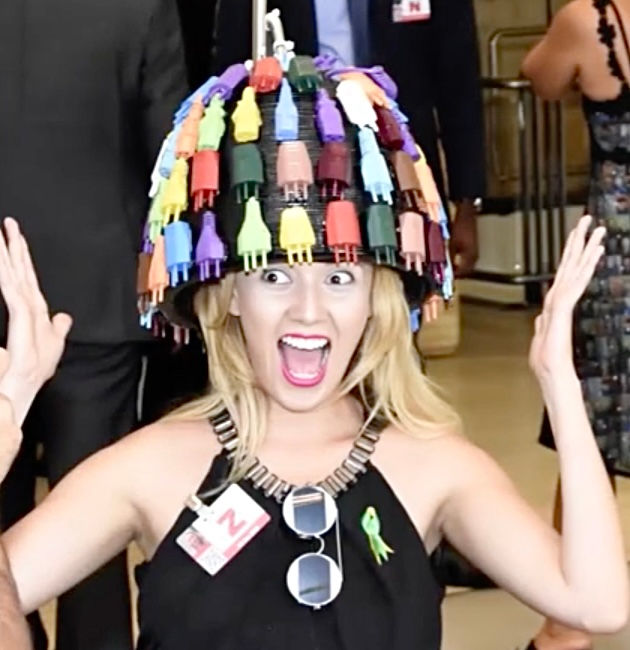

Na Pele Delas is an installation that precedes "O Grito" and forms part of the series As Marias. Composed of helmets and recycled tires, the work represents four Brazilian women and addresses issues of invisibility, labor and social identity.
First presented in 2018 during Human Rights Week at the United Nations Palace in Geneva, the installation invites the viewer to inhabit the perspective of these women, proposing empathy as both a physical and ethical experience.
In 2019, the work was acquired and exhibited by Personal Structures, organized by the European Cultural Centre, in the context of the Venice Biennale.
Meu Nome é Maria das Dores (My Name is Maria das Dores)
An installation that weaves voice, image and materiality to reveal how individual identities echo within collective narratives of pain, resilience and representation.


My Name Is Maria das Dores emerges from the encounter between name, memory, and collective identity.
Starting from the first work of the As Marias series, Leca Araujo unfolds a sensitive investigation into the symbolic layers that permeate the female experience in Brazil.
The installation is composed of a video and a double monotype, produced from the same matrix:
— an ephemeral version, printed on plastic,
— and a durable version, transferred onto linen.
These two pictorial bodies materialize the tension between what dissolves and what endures — between the fragility of individual narratives and the historical persistence of roles imposed on women.
The video brings together real testimonies from women named Maria das Dores, collected by the artist across different regions of Brazil. Their voices, marked by singular life stories, form an intimate and collective chorus that challenges stereotypes, reclaims the name, and restores humanity to what has long been reduced to a social label.
By articulating image, word, and material, My Name Is Maria das Dores proposes a reflection on pain, resilience, and visibility, transforming the proper name into a poetic and political territory.
Presented at the Palais des Nations in Geneva, in dialogue with the installation In Their Shoes, the work affirms listening as an artistic gesture and memory as a form of symbolic repair.
Na Contramão (Against the Current)
An installation born from listening, where art and education converge to restore visibility, authorship and voice to narratives often kept at the margins.


Na Contramão emerges from the intersection of art, education, and active listening.
Developed through workshops led by Leca Araujo with children from the Djalma Maranhão Municipal School in the Vidigal favela, Rio de Janeiro, the installation brings together drawings, handwritten letters, reinterpretations of the series As Marias, and a documentary video presented on a tablet and integrated into a wall of visual and emotional memories.
More than a pedagogical record, the work creates a space of visibility for narratives that rarely occupy the center of cultural institutions. The children are invited to reinterpret the female figures from As Marias, projecting their own perceptions, emotions, and questions regarding identity, belonging, and the future.
The letters and images reveal a fundamental gesture: restoring voice and authorship to subjects often shaped by external narratives. Here, creation is not conducted about the children, but with them — in a process where pedagogy becomes artwork and education becomes artistic material.
Presented at the Palais des Nations in Geneva, Na Contramão shifts the viewer’s gaze. Rather than contemplating from a distance, the audience is invited to read, listen, and recognize. The installation proposes a symbolic inversion — from the margins to the center, from silence to speech, from statistics to faces.
The work thus aligns naturally with Leca Araujo’s broader artistic trajectory, extending her ongoing exploration of empathy, representation, and collective responsibility, and affirming art as a space for listening, construction, and transformation.